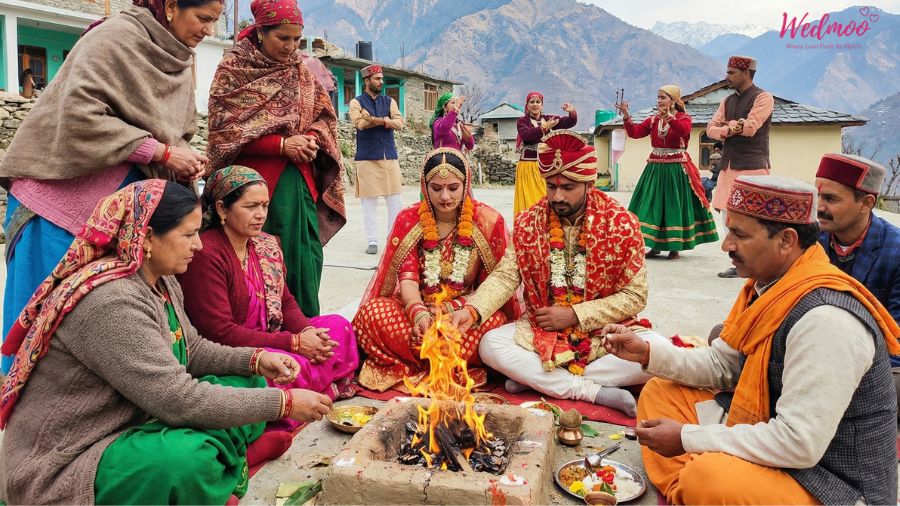

Marriage rituals followed in Kangra, Mandi, and Kullu include Vedic traditions with local Pahari rituals, including Dhamu, Roka, Puttimanal, Feroni, and more. With community involvement and folk music, the upper caste weddings often follow the Biah or Vedic form, while other communities in the area prefer simpler rituals like Jhajar or Gaddar.
Pahari marriage rituals in Kangra, Mandi, and Kullu are a beautiful blend of Vedic traditions and local Pahari customs, with Pahari matrimony platforms like Wedmoo. It often incorporates community participation, folk music fusion, and rituals performed with distinct methods, which drapes it in a stunning and magical layer of cultural immersion. Here, explore the unique customs of Pahari weddings, including Kangra, Mandi, and Kullu, that may leave you in awe.
What are the Pre-Wedding Rituals of a Pahari Wedding?
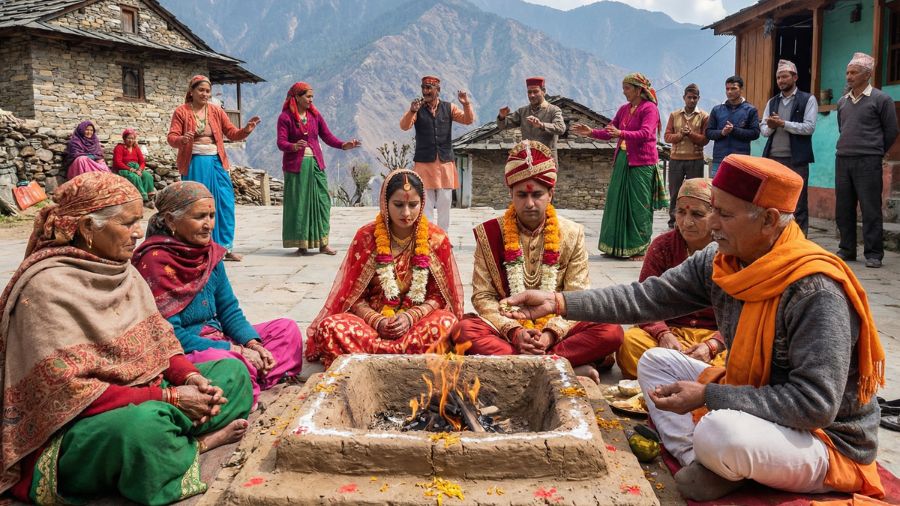
Here are the pre-wedding rituals in Kangra, Mandi, and Kullu weddings:
- Dhamu or Matchmaking: In Himachal Pradesh, finding a partner within the same community is highly preferred. That is why Dhamu or matchmaking involves a pahari matrimony platform or an elderly person of the home to find a suitable life partner.
- Roka or Sagai or Barni: After kundali and gotra matching, a roka or engagement ceremony is held to finalise the wedding. The name for the roka differs areawise in Kangra, Mandi, and Kullu, but the customs remain the same with slight celebration differences.
- Mama Swagat: Mama Swagat is a unique ceremony before a wedding, where the bride’s maternal uncle is invited to the groom’s house. As the marriage connects the families as well, this custom takes place with folk music, sweets, gifts, and warm greetings.
- Haldi or Samuhat: Haldi rasam is practiced widely in India, so in Kangra, Mandi, and Kullu Pahari rishta marriages. In which turmeric paste is applied by the relatives to the groom and bride in their respective homes.
- Sehra Bandi: The groom wears a traditional turban (sehra), which is tied by his brother-in-law (bride’s brother), followed by a customary tika, before the main wedding rituals.
How Are Wedding Day Rituals Held in Pahari Weddings?
Wedding day rituals that are held in Pahari weddings:
- Jang or Baraat: Like any vibrant wedding in India, in Himachal Pradesh too, the groom’s procession is held with folk music accompanied by traditional dhol (drums) for the bride’s home.
- Milni: After a vibrant procession of the groom’s baraat, when they arrive at the bride’s home, the bride’s family there welcomes them with garlands and sometimes with Naak Pakdaii, an ages-old custom, performed by the bride’s mother. In this, she grabs the groom’s nose, signifying playful welcoming.
- Kanyadaan and Pheras: During the wedding, the bride’s father performs Kanyadaan, signifying giving her responsibility to the groom. Then, in the Kangra marriage, the traditional custom of saat phere or 7 pheras is performed under a priest’s guidance.
- Nath Ritual: The Nath ritual is equivalent to the 7 pheras of the usual marriage customs, or replacement in the Mandi marriages. In this, the priest inserts a nath (nose ring) into the girl’s nose, brought by the groom’s family.
- Puttimanal: In Kullu marriages, instead of the nath custom, a traditional cap is placed over the bride’s head, signifying a strong Pahari rishta (relationship) between the groom and bride.
- Dham: Dham is common in all the traditional Himachal Pradesh weddings, where a massive feast is prepared for the guests and served on banana leaves or traditional plates.
Are There Post-Wedding Rituals in Pahari Weddings?
Yes, there are post-wedding rituals held in Himachali weddings, like any traditional wedding in other parts of India. Here are the traditional rituals that are held after marriage:
- Vidaai or Andaron: After the marriage is completed, an emotional farewell is held. This is more than a common happening; it is a tradition or a custom. This can be referred to as the farewell of the bride from her parental home.
- Grah Pravesh: In Grah Pravesh, the bride is welcomed at the groom’s house with distinctive traditions, including the Kalash Rasam, Kheer, and Daran (apricot tree).
- Feroni or Murapull: Feroni is the last custom after a traditional wedding in Himachal Pradesh, in which the bride returns to her home (parental home) after 2 or 3 days of the wedding.
What Region-Specific Customs are Followed in Kangra, Mandi, and Kullu Marriages?
In the traditional weddings of Kangra, Mandi, and Kullu, most of the customs are common and performed similarly, like the pahari rishta matchmaking. However, some of the rituals may differ, which include the 7 phera, nath ritual, and cap ceremony.
Below is a table for a better comparison of all three areas’ weddings:
| Feature | Kangra | Mandi | Kullu |
| Main Ritual | Traditional 7-Pheras (Biah) | Jhajra or Nath insertion | Puttimanal (Cap ceremony) |
| Signature Item | Roka & Thaka | Sepu Badi | Meetha Bhatt |
| Key Custom | Gheraphera | Murapull (after 3 days) | River crossing restriction |
| Traditional Attire | Elegant silk outfits with regional jewelry | Heavy ornaments with Nath (nose ring) | Colorful woolen attire with a Himachali cap |
| Wedding Atmosphere | Includes rituals and structured | Cultural and community participation | Festive and connected with nature |
| Music & Dance | Folk songs and dhol performances | Traditional Mandiyali music | Nati dance and local instruments |
| Pre-Wedding Rituals | Roka and engagement ceremonies | Family customs and gatherings | Community celebrations |



Conclusion
The marriage customs of Himachal Pradesh weddings are not merely sacred rituals. They are the symbols of forever bonds that tie the bride and groom together, along with their families. Here, we explored what traditional customs are performed in Pahari weddings of Kangra, Mandi, and Kullu. We also discussed how these customs are performed with their unique, distinctive rituals.
Wedmoo stands as one of the leading and most trusted matrimonial sites in Himachal Pradesh. With services tailored to your preferences, we assist you in finding partners who belong to the same community, traditions, and embrace the same values as you. Our expert team always stays in touch with you, from profile optimization to personal guidance. So, stop waiting for the right time and reach out to us to find the ideal life partner.