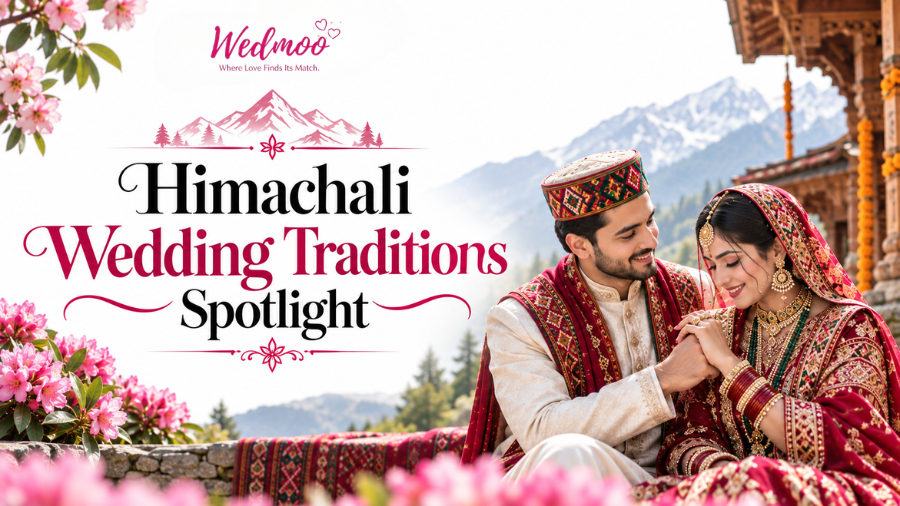

A Himachali wedding is a multi-day celebration that is deeply rooted in community, customs, and age-old traditions. These Himachali wedding traditions, from pre-wedding rituals like Mama Swagat or Sahra Bandi to post-wedding rituals, each one adds a unique flavor to the wedding.
A Himachali wedding is not just a ceremony; it carries age-old traditions, rituals, and culture molded by the local community and generations of families. Be it the traditional attire, food, music, and folklore, every detail is a complement and offers a glimpse into Himachal’s rich cultural life. The Himachali wedding traditions start before the main event, just like any other wedding in any part of India. But it contains several unique rituals and beliefs, which you can encounter only in Himachal Pradesh. Thus, these traditions are what give the local, unusual-to-see character to the wedding.
Himachali Wedding Traditions
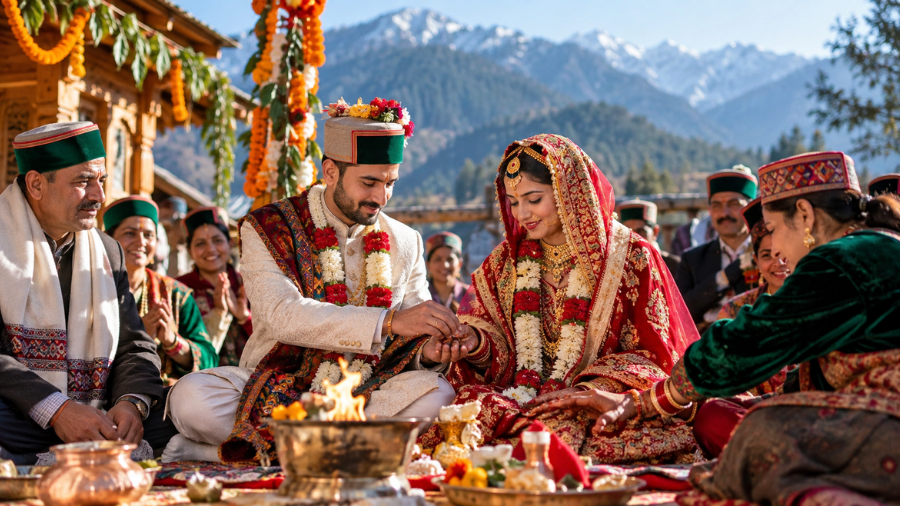
The Himachali wedding traditions are centuries to thousands of years old, anchored in Vedic scriptures, local mountain folklore, and tribal heritage. Some of the most famous rituals, such as Pheras (walking around the sacred fire) and Saptapadi, come directly from the Vedic traditions that are followed across India with some differences. Traditions such as the post-wedding Dhaam and folk music were developed within the local Himachali community over the years.
Setting the Wedding in Motion: Pre-Wedding Wedding Traditions
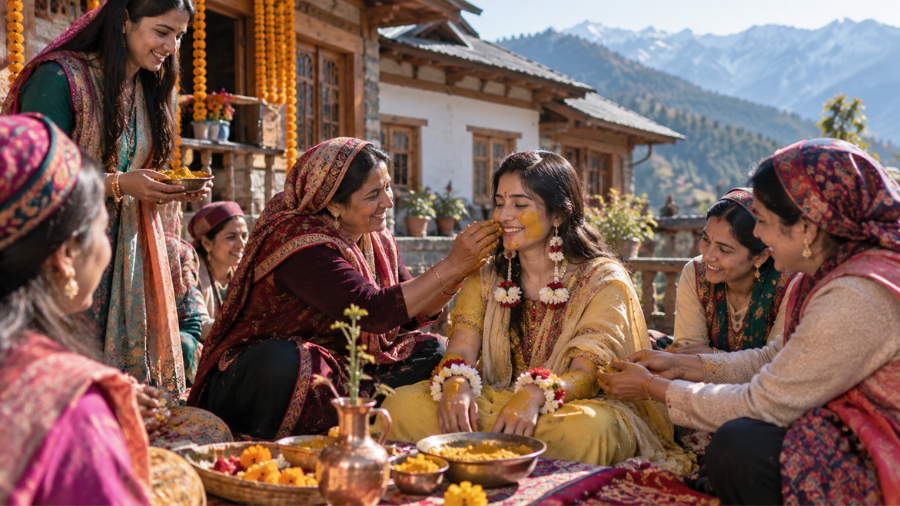
Himachali wedding traditions are divided into three phases: pre-wedding, on the ceremony day, and post-wedding traditions. Each one has its own uniqueness, combining the Vedic traditions with local communal rituals. In addition to that, pre-wedding traditions are what set the emotional stage for the whole wedding, particularly for the main ceremony.
Pre-Wedding Traditions
1. Roka and Thaaka
The wedding journey starts with the roka, where families approve the marriage. This custom is followed by thaaka, where they finalize the wedding date and exchange gifts, sweets, dry fruits, or jaggery.
2. Kul Devta Puja
Then, before moving forward in the marriage, they make sure that the marriage gets the blessings and protection of their Kula Devta. Every village in Himachal Pradesh has its own deity, which is the reason why there are many. Some of them include:
- Lord Raghunath,
- Hadimba Devi,
- Bhimakali Devi,
- Baba Nahar Singh Veer, and various Shakti Peethas.
3. The Haldi Ceremony
The haldi and mehendi ceremony is one of the joyful pre-wedding rituals that also takes place in Himachali weddings. In these ceremonies, the respective families of the bride and groom apply a paste of turmeric, with sandalwood powder, rose water, and oils onto their bodies, giving a natural glow for the wedding.
4. Mehendi and Sangeet
Mehendi and Sangeet also happen in the traditional Himachali wedding. Women apply mehendi on the bride’s and each other’s hands. They also sing folk songs, dance the Nati, and celebrate the occasion.
5. Mama Swagat
The mama swagat is another Pahari custom that is followed in the Himachali wedding traditions. In this, the maternal uncle, with his family, arrives at the home with a ceremonial chunri for the bride. His coming is celebrated with music, feasts, and sweets.
The Beauty of Himachali Wedding Attire
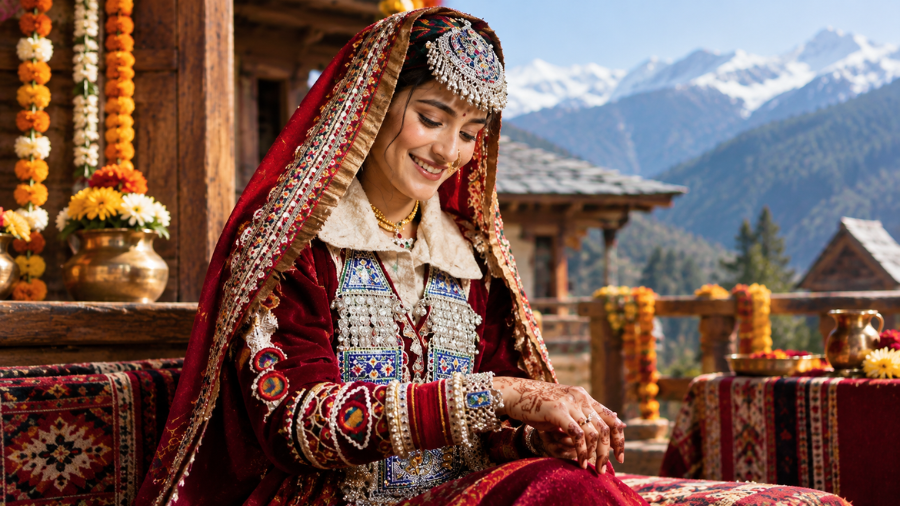
Himachali wedding attire is a reflection of the Pahari lifestyle, environment, and local culture, thriving for centuries. In traditional weddings, rich handwoven woolens and bright crimson and gold fabrics are worn with intricate silver or gold jewellery.
Furthermore, in many modern Himachali weddings, it is clearly visible that people are combining traditional Pahari elements with contemporary fashion styles. This balances the mountainous warmth with handloom craftsmanship and modern aesthetics.
The Bridal Attire
- Luanchdi
Luanchdi is a classic Himachali attire, consisting of a long, flowing flared skirt, which is paired with a matching choli. It is an ethnic dress of the Gaddi tribe, which typically comes in deep red and is combined with golden embroidery, featuring flowers, fauna, and designs for the wedding.
- Pattu and Dhatu
Pattu is a large handwoven woolen shawl that a bride wears as protection against cold winds. It is often worn with silver brooches called boomni, that enhances the overall look. On the other hand, a dhatu is a colorful scarf, also in red or a similar color, tied on the head to protect from the cold.
The Groom Attire
- Sherwani or Kurta-Pajama
The groom, in Himachali wedding traditions, typically wears a sherwani or long kurta paired with a dhoti or churidar pajama. The sherwani is usually rendered in classic beige or matched with the bride’s attire. The color of the pajama or dhoti remains off-white or in a darker shade of the sherwani.
- Himachali Topi
Much like other traditional weddings in other parts of India, where the groom wears a sahra, in a Himachali wedding the same thing is replaced with a customary Pahari topi or Himachali cap. This accessory is worn usually on a daily by Pahari people. But on the wedding day, it becomes one of the most unique elements that a groom wears with a ceremonial floral garland or sehra.
Himachali Wedding Day Traditions and Rituals
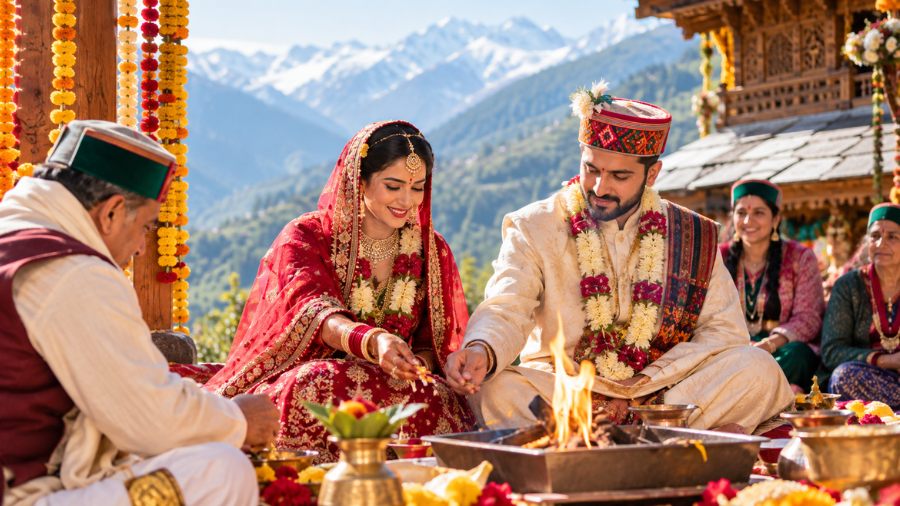
Here are the wedding day traditions and rituals in Himachal Pradesh:
1. Baraat Procession
The groom and his family, along with relatives and friends, arrive at the bride’s home or the venue of the wedding. They arrive with traditional dhol, local instruments like nagara, and folk songs.
2. Milni and Swagat
The family of the bride welcomes the groom with sacred rituals like aarti and tilak, vara puja, garlands, sweets, and joyful teasing when they arrive at the venue.
3. Sahra Bandi
After the welcoming, Himachali wedding traditions are performed; the groom wears the traditional Pahari cap, ornate with usually non-precious jewelry and floral decorations. Then, a sahra is attached to the cap, covering his face.
4. Jaimala
Families of the bride and the groom arrive at the mandap with garlands of fresh roses or other regional flowers. Then both bride and groom exchange the garlands with sometimes playful teasing.
5. Kanyadaan
Then, an emotional ceremony takes place, which we famously know as Kanyadaan. In this ceremony, the bride’s father gives away her hand to the groom. This reflects that the father is giving the responsibility for her care, protection, and partnership to the groom.
In addition, many people perceive it as the bride being treated as an object, but that is not true; it’s about entrusting the groom with his daughter’s responsibility and care.
6. Saptapadi
After traditional local rituals, a sacred cloth is tied between the groom and bride’s attire. Then the couple is asked to take seven rotations or pheras around the sacred fire. These 7 pheras are also known as the Seven Vows of a traditional Indian marriage that they both need to comply with for life.
- First Phera: A promise to provide nourishment, food, and care.
- Second Phera: A prayer for physical, mental, and spiritual health.
- Third Phera: A commitment to prosperity, wealth, and wise financial management.
- Fourth Phera: A pledge to share happiness, respect, and maintain harmony.
- Fifth Phera: A prayer to God for a happy family life and virtuous children.
- Sixth Phera: A prayer for health and a joyous life with each other.
- Seventh Phera: A vow taken for companionship, loyalty, and friendship for a lifetime.
7. Sindoor Daan and Mangalsutra
After the seven pheras, the groom applies sindoor or vermilion in the parting of hair of the bride. Followed by a mangalsutra necklace, which is tied around the bride’s neck.
Rituals Take Place After the Wedding in Himachal Pradesh
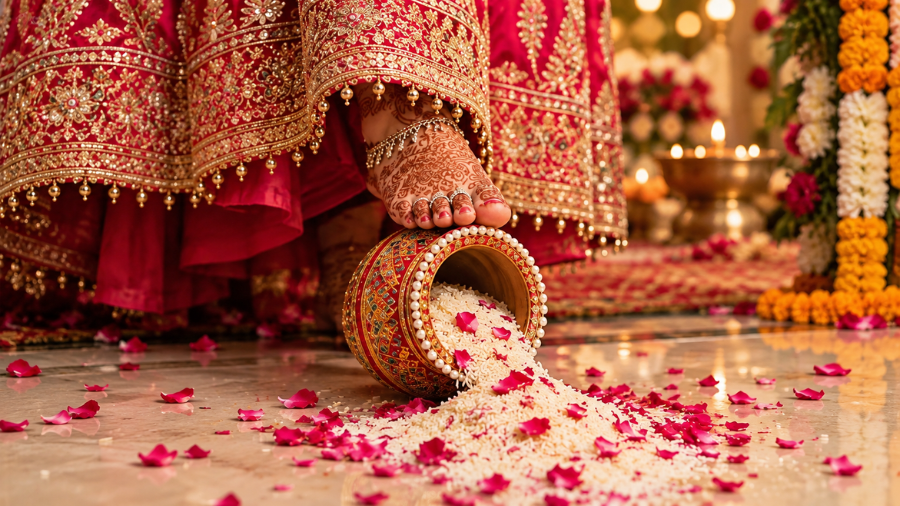
Along with the grand feasting, here are the rituals that take place after a Pahari wedding:
- The Grand Dham
The grand dham is a multi-course vegetarian feast prepared by the traditional cooks called Botis. As a major part of Himachali wedding traditions, dham started around 1,000 years ago from the Jaistambh of Chamba. This tradition started during his reign because he desired a royal vegetarian feast inspired by the Wazaan of Kashmiri tradition.
Moreover, in the wedding, vegetarian dham is prepared by keeping without onion, garlic, or ginger out from the ingredients for a Satvik feast. In regions like Kangra, Mandi, and Chamba, a classic wedding features a variety of dishes including:
- Rice and Moong Dal,
- Madra,
- Dal and Kadhi,
- Khatta,
- Sepu Badi,
- Meetha Bhaat, and others.
- Bidaai
As the wedding reaches its end, an emotional ceremony drapes the atmosphere in heaviness and tears. Bidaai translates to farewell, reflecting the time the bride has to leave her home, where she grew, had dreams, and where she was cherished. The bride departs by performing a last ritual of tossing rice backward over her head.
- Grah Pravesh
When the bride arrives at the groom’s home, she is welcomed with local rituals like knocking over a kalash filled with rice. The groom’s family prepares the home for the arrival with rituals and local traditions, such as:
- The Sacred Wall Art (Chaj Char),
- Handprint Ritual (Hastachinha),
- Ganesh Puja, and others.
Conclusion
Himachali wedding traditions range from pre-wedding roka and sagaai to wedding day grand dham and post-wedding grah parvesh. Grounded in history for centuries, this combination of local Pahari traditions and Vedic rituals with modern elements gives a unique flavor to the wedding. Some of them, such as the unique wedding attire of the bride and groom, steal the spotlight, making people wonder about their beauty and uniqueness.
A Himachali wedding is an occasion that follows traditions, rituals, and local customs. So, if you also want a Pahari wedding for yourself but have not found the right partner, you can reach out to Wedmoo. We are a Himachal-based matrimonial platform that helps individuals find a Pahari partner with similar values, cultural background, and family traditions.
Our platform provides you with advanced filters so you can find a match compatible with your needs. You also get professional assistance from our team at every stage. Thus, visit Wedmoo and find the perfect Pahari partner for you today.
Also Read: Pre-Wedding Shoot Locations In Himachal